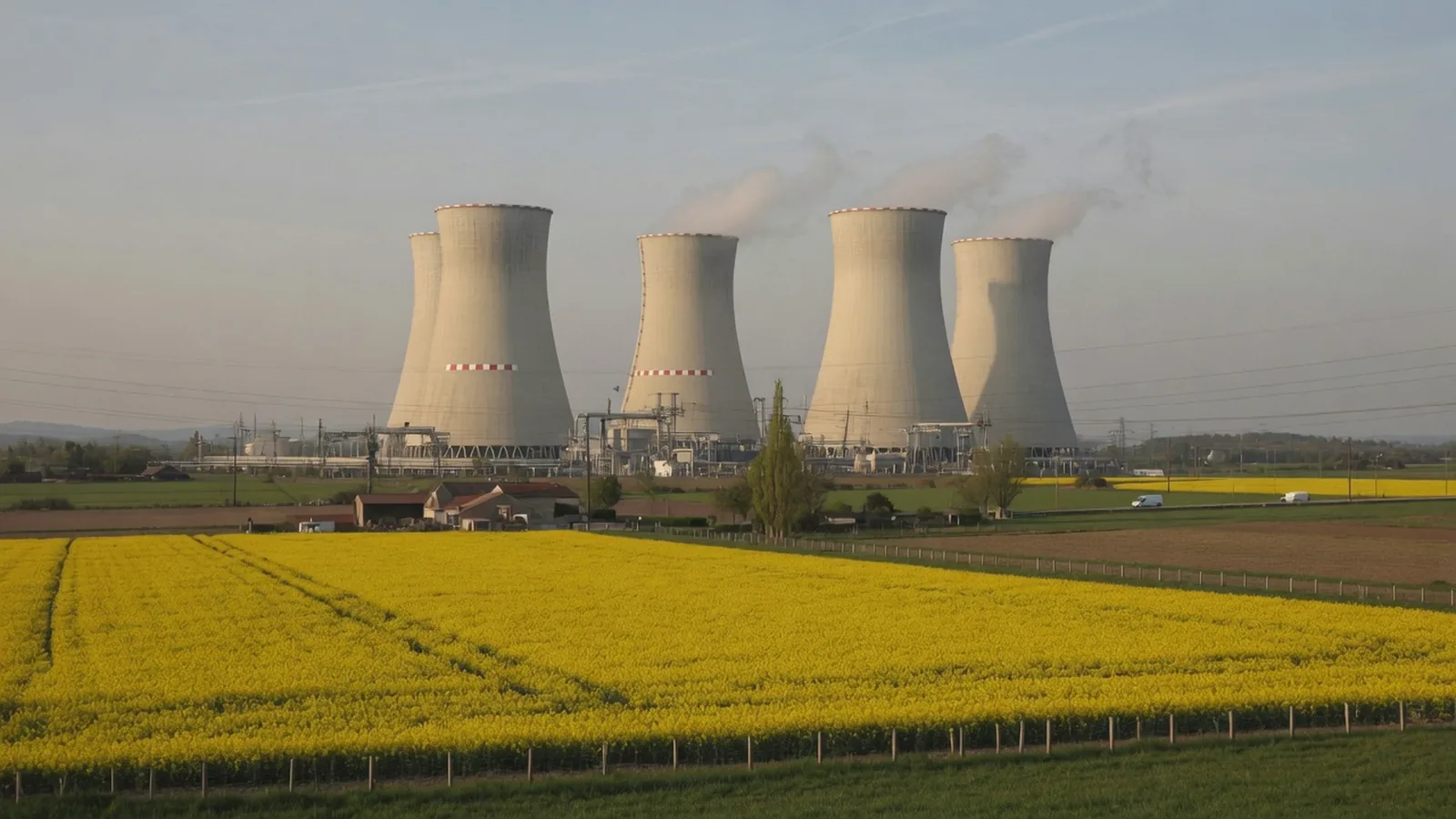
France generates approximately 70% of its electricity from nuclear power — a higher share than any other country in the world. This is not an accident of geography but the result of a strategic decision made in 1974, after the first oil crisis, by President Georges Pompidou (continued by Giscard d'Estaing): France, which has no significant domestic oil or gas reserves, would achieve energy independence through nuclear fission. Fifty years later, the programme électronucléaire (the French nuclear power programme) is one of the most successful industrial ventures in modern history — and one of the most consequential.
The Numbers
| French Nuclear Power | Detail |
|---|---|
| Reactors in operation: 56 (all operated by EDF) | |
| Installed capacity: ~61 GW | |
| Share of electricity generation: ~70% | |
| Nuclear electricity exported: France is Europe's largest net electricity exporter | |
| Operator: EDF (Électricité de France) — majority state-owned | |
| Fuel cycle: Orano (formerly Areva) manages uranium mining, enrichment, and reprocessing | |
| New build: EPR (European Pressurised Reactor) at Flamanville (delayed, commissioning 2024–25); 6–14 new EPR2 reactors planned | |
| CO₂ emissions per kWh: ~50g (among the lowest in the world) |
How France Went Nuclear
The Decision (1974)
The 1973 oil crisis exposed France's vulnerability: it imported over 75% of its energy. The Plan Messmer (the Messmer Plan — Prime Minister Pierre Messmer's 1974 decision to launch a massive nuclear construction programme) launched an unprecedented construction programme: 56 reactors built in approximately 15 years, using a standardised design (the Pressurised Water Reactor, licensed from Westinghouse and progressively Gallicised).
The decision was taken without a referendum. It was executed by EDF — a state monopoly with the engineering talent, the capital, and the political support to move fast. The standardisation was key: unlike the US, which built dozens of reactor designs, France built essentially one design in three sizes (900 MW, 1,300 MW, 1,450 MW). This reduced costs, simplified regulation, and accumulated operational experience rapidly.
The Result
By 1990, France had the cheapest electricity in Western Europe, near-zero CO₂ emissions from power generation, and energy independence from fossil fuel imports (for electricity). The programme is estimated to have avoided billions of tonnes of CO₂ emissions compared to a fossil-fuel alternative.
The Industry
EDF
Électricité de France (the French national electricity company — operator of all nuclear plants) is the world's largest nuclear operator. A majority state-owned company (~84% government shareholding since its full renationalisation in 2023), EDF operates all 56 French reactors plus two in the UK (Sizewell B and Hinkley Point C under construction). EDF is also a major player in renewables, hydropower, and electricity distribution.
EDF's challenges are significant: an ageing reactor fleet (average age: ~38 years), corrosion issues discovered in 2022 that temporarily shut multiple reactors, massive debt (~€65 billion), and the cost overruns of the Flamanville EPR (originally budgeted at €3.3 billion, final cost ~€13.2 billion).
Orano
Orano (the French nuclear fuel cycle company — formerly Areva) (formerly Areva) manages the nuclear fuel cycle: uranium mining (in Canada, Niger, Kazakhstan), conversion, enrichment, fuel fabrication, and — crucially — reprocessing. France is one of the few countries that reprocesses spent nuclear fuel, at the La Hague facility in Normandy (the world's largest reprocessing plant), extracting reusable plutonium and uranium and reducing the volume of high-level waste.
Framatome
Framatome (majority-owned by EDF) designs and manufactures reactor components, including the pressure vessels, steam generators, and control systems. It is France's reactor technology company and the designer of the EPR.
The CEA
The Commissariat à l'Énergie Atomique et aux Énergies Alternatives (the Atomic Energy Commission — France's nuclear research agency) (CEA) is the research agency behind French nuclear technology. It operates major research centres at Saclay (near Paris), Cadarache (Provence), and Marcoule (Gard). The CEA also manages France's nuclear weapons programme.
The EPR and the Future
Flamanville
The EPR (European Pressurised Reactor) at Flamanville, Normandy, is France's first new reactor in 25 years. Its history is a cautionary tale: construction began in 2007, scheduled for completion in 2012 at a cost of €3.3 billion. It was finally connected to the grid in 2024 at a cost of approximately €13.2 billion. Welding defects, regulatory delays, and industrial skill attrition (France had not built a reactor since 1991) caused repeated setbacks.
The New Programme
Despite Flamanville's difficulties, France is committed to new nuclear: President Macron announced in 2022 a programme to build six EPR2 reactors (a simplified, cost-reduced EPR design), with options for eight more. The first pair are planned for Penly (Normandy), with a target start date of 2035.
The rationale: decarbonisation. France's electricity is already low-carbon (thanks to nuclear), but the electrification of transport, heating, and industry will require significantly more generation capacity. Replacing ageing reactors and expanding capacity simultaneously is the challenge of the next three decades.
SMRs
France is also developing small modular reactors (SMRs) — specifically the Nuward project (EDF/CEA), a 340 MW design intended for deployment from the mid-2030s.
The Politics
Nuclear power in France enjoys broader political support than in almost any other democracy. The right supports it for energy independence and industrial employment. Much of the left supports it for climate reasons and because EDF is a public company with strong unions. The Greens oppose it, but they are a minority voice.
Public opinion is broadly supportive, though the 2022 corrosion crisis (which temporarily reduced nuclear output by ~30% and contributed to electricity price spikes) tested confidence. The Fukushima disaster (2011) prompted debate but no policy change — unlike Germany, which shut down its entire nuclear fleet.
Energy Transition — How nuclear fits into France's broader energy transition — renewables, efficiency, and decarbonisation.
French Rivers & Waterways — The cooling water systems and river environments that nuclear plants depend on.
On the ground
| Pin | Working note |
|---|---|
| Page | Nuclear Energy in France: The World's Most Nuclear Nation |
| Desk | Le Moteur |
| First use | Read the pins, then one related page — not five |
| Confirm | Official site or ticket desk the week you go |
The useful unit is one place or one question, not a fourteen-day montage of France. Nuclear Energy in France: The World's Most Nuclear Nation sits in a country that is easy to over-plan and easy to under-prepare. The industries layer is where visitors collect names. This page is the opposite: what to do first, what to skip, and which sibling guide holds the rest.
France rewards a slow unit. One arrondissement, one valley, one appellation, one park trail. The photograph of five landmarks in five days is a real holiday, and it is also a queue with a passport. If you only have three nights, spend two of them in the same bed. The third night is for a train, not a third hotel.
Working a visit
Practical France is sockets (Type E/F, 230 V), tap water that is safe, pharmacies that are the real clinic for minor trouble, and a lunch hour that still closes a village. Cards work in cities. Cash still opens some park kiosks, some island boats, and some market stalls that have never seen contactless. A lightweight adapter belongs in the personal item, not the hold.
We will not write as if every reader is on a gap year, or as if every reader is in a palace hotel. We will not flatten 'the south' into one climate. We will not treat a strike day, a jour férié, or a Tuesday museum closure as a personality quirk of the French. They are calendars. Check them. Then use Nuclear Energy in France: The World's Most Nuclear Nation as a pin, not as scripture.
Cross the five guides instead of cloning them. La Porte holds trains and the first week. La Terre holds weather and park gates. L'Esprit holds museum Tuesdays and the Revolution. La Table holds the market morning and the wine list. Le Moteur holds the Tour, the working week, and why August is empty in Paris and full on the coast.